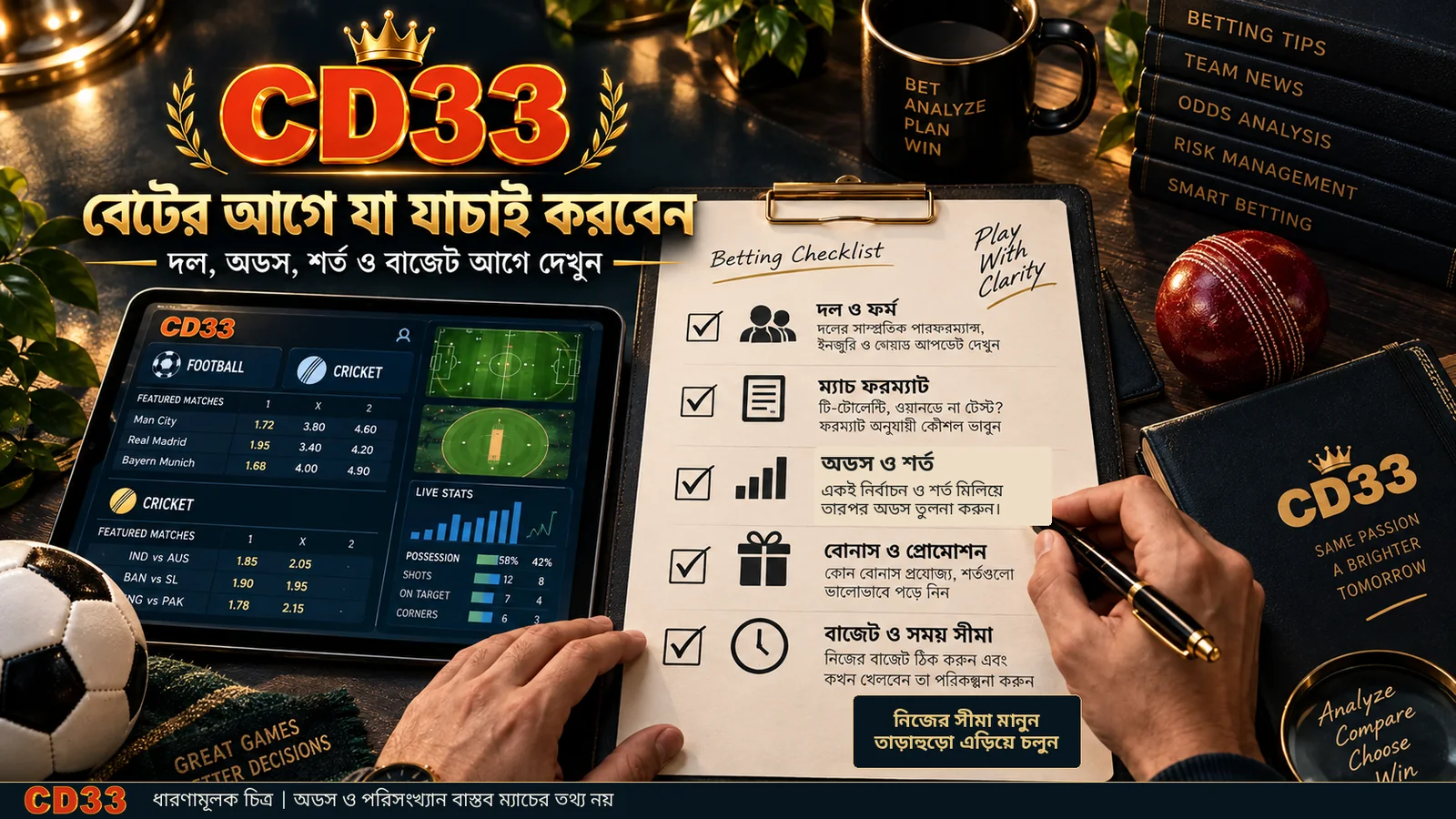
CD33 Betting Tips – Understand Cricket, Football and Odds Before Making a Decision
Knowing about a match and understanding the conditions of a bet on that match are two different things. Your favourite team playing well, low odds on the screen or a confidently written analysis cannot guarantee the result. That is why this CD33 betting tips guide starts with reading the information, understanding what it means and keeping your own limits in mind. The article covers cricket scores and overs, football form and line-ups, live updates, common bet types and promotion terms. The examples use taka and familiar match situations to make them easier for readers in Bangladesh to follow. This is not a set of match predictions or a promise of profit; the aim is to explain the information you see on the screen.
Six essential principles for beginners
Understanding a sport makes analysis easier to follow, but it does not remove uncertainty. Before making a decision based on a number or an opinion, keep these six points in mind.
1. Read statistics in context
Hearing that a team is “unbeaten in its last five matches” and assuming it won all five is a mistake. That run could include two wins and three draws. When looking at statistics, check how many matches are included, which period the data covers and who the opponents were. A short headline may leave out important details. Past results tell you what happened, not what will happen in the next match.
2. Spending a fixed percentage does not mean the risk is lower
A rule such as using 5% of your budget each time does not make betting safe. Repeated spending can still lead to substantial total losses. Keep money for food, rent, education, debt repayments and emergencies separate. Do not borrow to keep betting or treat betting as a way to solve financial difficulties. As well as knowing how much money you have, you need to understand how much you could lose.
3. Clear up anything you do not understand first
Recognising a team's name does not mean you understand the conditions of a bet. Some figures apply to the whole match; others cover only one half or a particular period. If you see an unfamiliar term or symbol, read its explanation first. Look at an example if needed. You do not have to overlook an unclear point and decide just because the team's name is familiar; choosing not to take part is also a valid option.
4. Do not treat odds as a guarantee of the result
Odds are the figures shown for a selection with specific conditions. Identical numbers can relate to different settlement periods or rules. Low odds do not mean a certain win, and high odds do not prove that an opportunity is good. Understand which selection the figure refers to and what the total return would be if it won. Looking at odds alone cannot tell you the full risk.
5. Check how current and reliable the information is
A predicted line-up is not the same as a confirmed line-up. In the same way, a forecast of rain and rain actually falling at the ground are different pieces of information. An old match report can also appear in search results. Check the publication date, update time and original announcement. Several assumptions pointing towards the same conclusion do not turn them into confirmed facts. If sources disagree, first find out why.
6. Take a break when emotions create pressure
Feeling an urge to recover lost money, spending more than planned or continuing beyond your intended time are all signals to stop. There is no guarantee that a run of losses must be followed by a win. Step away from the screen and focus on something else. If you find it difficult to stop, speak to someone you trust or seek appropriate support. Do not add more money just to make up for what you have lost.
Cricket, football and live information
Choose a section to learn about formats, scores, settlement periods and the details you need to check.
Cricket: understand the format, overs and score
To understand a cricket statistic, you need to read the details alongside it. How many runs has the team scored, how many balls have been bowled, how many wickets have fallen and what format is being played? Reading these together gives the score its meaning.
T20, ODI and Test statistics need to be read differently
These three formats do not share the same structure. Do not compare a T20 innings with an ODI or Test innings using the run total alone. The number of deliveries bowled and the stage of the innings reflected in the data also matter. The same total can mean different things in different situations. Check the format and the period covered before comparing figures.
What does “10.2 overs” actually mean?
An over normally consists of six valid deliveries. So 10.2 overs means 10 overs plus 2 valid deliveries. It is not 10.2 overs expressed as a decimal. When following the progress of an innings or reading related statistics, remember that the digit after the point represents deliveries. Missing this small distinction can lead you to misunderstand the figures.
What does a score of “120/3” tell you?
A score of 120/3 means the team has scored 120 runs and lost 3 wickets. It describes the position at the moment the score was recorded. That number alone cannot tell you who will win. Distinguish between the current run total, the target being chased and the final result. Read the overs and match status alongside the score as well.
Average runs per innings and batting average are different
Suppose a batter scores 20 and 40 runs in two innings and is not out in one of them. The total is 60 runs, but changing the basis of the calculation changes the average. For average runs per innings, divide total runs by the number of innings. For batting average, divide total runs by the number of dismissals.
Do not guess the effect of weather or a revised target
A forecast of rain does not mean the match will definitely be interrupted. A predicted line-up is not guaranteed to remain unchanged either. If a match is shortened, read the official announcement of the new over limit and revised target. Do not invent a new target from the earlier score. When taking notes, record the format, time, runs and wickets together; do not use one statistic as a substitute for the whole analysis.
Football: understand form, line-ups and the settlement period
When reading football information, you need to understand the competition as well as the teams. Line-ups, recent results and goal statistics help you follow an analysis, but they do not remove the risk of betting.
Compare home and away results separately
The venue is part of the context. Playing at home does not guarantee a win. When comparing results, check how many matches are included, who the opponents were and how long a period the statistics cover. Avoid drawing broad conclusions from a handful of results. Combining a team's home and away figures can also remove useful context.
Check line-ups and player news separately
Do not treat a predicted line-up in a news report as the official team sheet. Changes in goal, defence or another position need to be considered alongside the way the whole team plays. Even a confirmed injury and a player's absence are not enough to determine a match result. Keep a clear distinction between published facts and speculation.
Understand the handicap correctly
A handicap is essentially a condition used to settle a bet. It is not a promise of lower risk. Read the sign before the number, the team it applies to and the period used to settle the result. Do not continue just because the term looks familiar. What matters is understanding how that handicap defines a win, a loss or a refund.
Check which period the goal statistics cover
Goal totals may cover a full match, the first half or another period. The average number of goals in previous matches does not guarantee the same number in the next one. Look at both the number of matches in the sample and the circumstances of each match. Do not read first-half data as if it represented a whole match.
Recent form and league position are different things
A team with a win–draw–draw–win–draw sequence is unbeaten in its last five matches, but has won only two of them. That sequence describes a recent period, not the points table for the entire season. If a report says a team is “in excellent form”, read the individual scores underneath. Even teams with the same number of wins may have faced different opponents and circumstances.
Distinguish regulation time, extra time and qualification
Competition rules matter when reading results from cups and leagues. A team may draw in regulation time but progress after extra time or a penalty shoot-out. Do not treat “win the match” and “qualify for the next round” as the same selection. Check the bet slip to see which period is used to settle the result.
Live betting: fast updates do not mean complete information
Betting while a match is in progress is called live betting. Scores, time and odds can change quickly, so pay attention to delays and processing status when reading the screen. You do not have to act immediately after every change.
Check the match and the stage of play
First check the team names, format and match time. Establish whether the selection covers the whole match, one half or a particular period. In cricket, read runs, wickets and overs together. In football, check the score and minute as well as whether play is ongoing, suspended or finished.
Video, scoreboards and odds do not update at the same time
A change in odds alone cannot tell you its cause with certainty. Video, scoreboards and announcements may update at different times. Information that arrives quickly is not always correct. If one source shows 0–0 and another shows 1–0, wait and check. Do not mix commentary or speculation with confirmed events.
Cash Out and withdrawing money are different
Where a service offers Cash Out, it is an offer to settle a bet before the final result. It is not the process of withdrawing money from an account balance. The amount offered, when the feature appears and the confirmation rules depend on the service. The return may be lower than the original stake. Do not treat Cash Out as a guarantee of keeping a profit or avoiding a loss.
6 basic betting tips for beginners at CD33
If you are new to CD33 betting tips, start with simple steps: understand the sport, read the market correctly and set a spending limit. No tip guarantees a win, but the steps below help you avoid misunderstandings when choosing a bet.
Choose a sport you understand
If you regularly watch football, learn about football bets first. If you know cricket, start with its formats and scoring. Do not choose a match just because other people mention it or assume a well-known team is certain to win.
Understand single bets before accumulators
A single bet has only one selection, making its conditions and result easier to follow. In an accumulator, one losing selection can make the entire slip lose. Beginners should read how each type works rather than combine several matches simply because the displayed return looks attractive.
Check the information before the match
Check the start time, confirmed line-ups and both teams' recent results. For cricket, also look at the format, pitch and weather. These details help you understand the match context; good past results still do not guarantee the next outcome.
Read both the market conditions and the odds
Before confirming, check whether the bet covers the full match or one half and whether extra time counts. At decimal odds of 2.00, a winning ৳100 bet returns ৳200 in total: the ৳100 stake plus ৳100 profit. If it loses, you lose the ৳100 staked. Low odds do not mean a certain win either.
Set money and time limits at the start
Decide in advance how much you can accept losing and when you will stop. Do not bet with money for living costs, debt repayments or money you have borrowed. Stop when you reach your limit; do not raise it because you have just won or want to follow one more match.
Do not raise your stake to chase losses
After a loss, do not rush into a larger bet hoping to recover the money. Take a break and check the result against the market conditions. If you feel impatient, do not understand the selection or lack clear match information, you can skip that match.
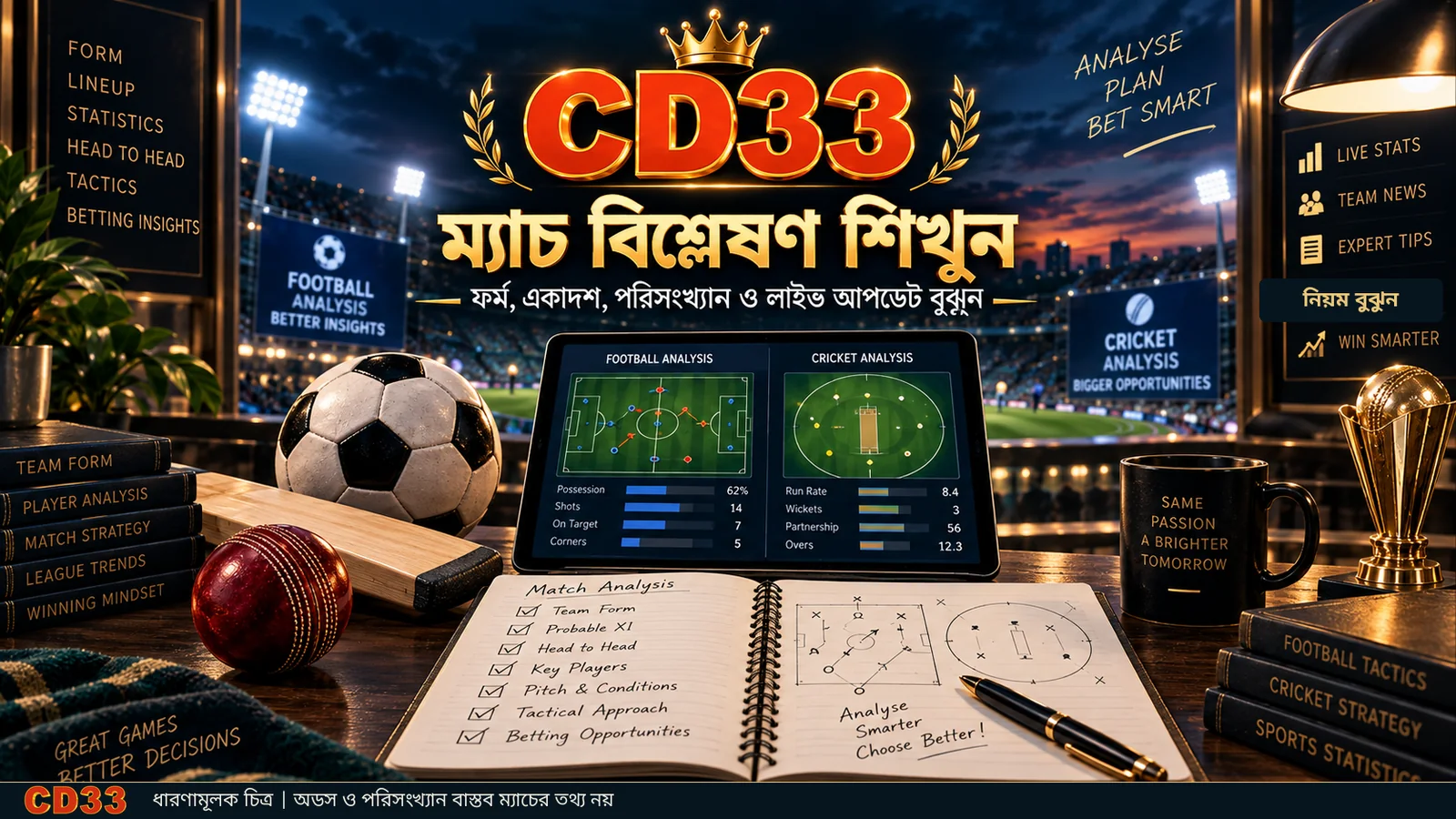
Promotions: read the full terms before focusing on the bonus
Extra benefits may catch your attention, but every offer has its own rules. To avoid confusion about bonuses, costs and withdrawals, read the full details rather than a short advertisement.
Compare eligibility and deadlines with your own limits
First check who is eligible, how long the offer lasts and whether a minimum deposit is required. Do not increase your planned spending just to qualify for a bonus. If an offer does not fit your limits, you can skip it. Accepting an offer is not an obligation.
Being able to use a bonus does not mean you can withdraw it
Read the wagering requirement, eligible sports or games, deadline for meeting the conditions and withdrawal limits separately. A bonus shown on the screen is not necessarily available for immediate withdrawal. If anything is unclear, ask for an explanation before registering or taking part.
Check the offer against the published announcement
Compare the message with the service's announcement and full terms. Do not send money, passwords or OTPs just because you have seen an unverified promotional message.
Bet types and examples
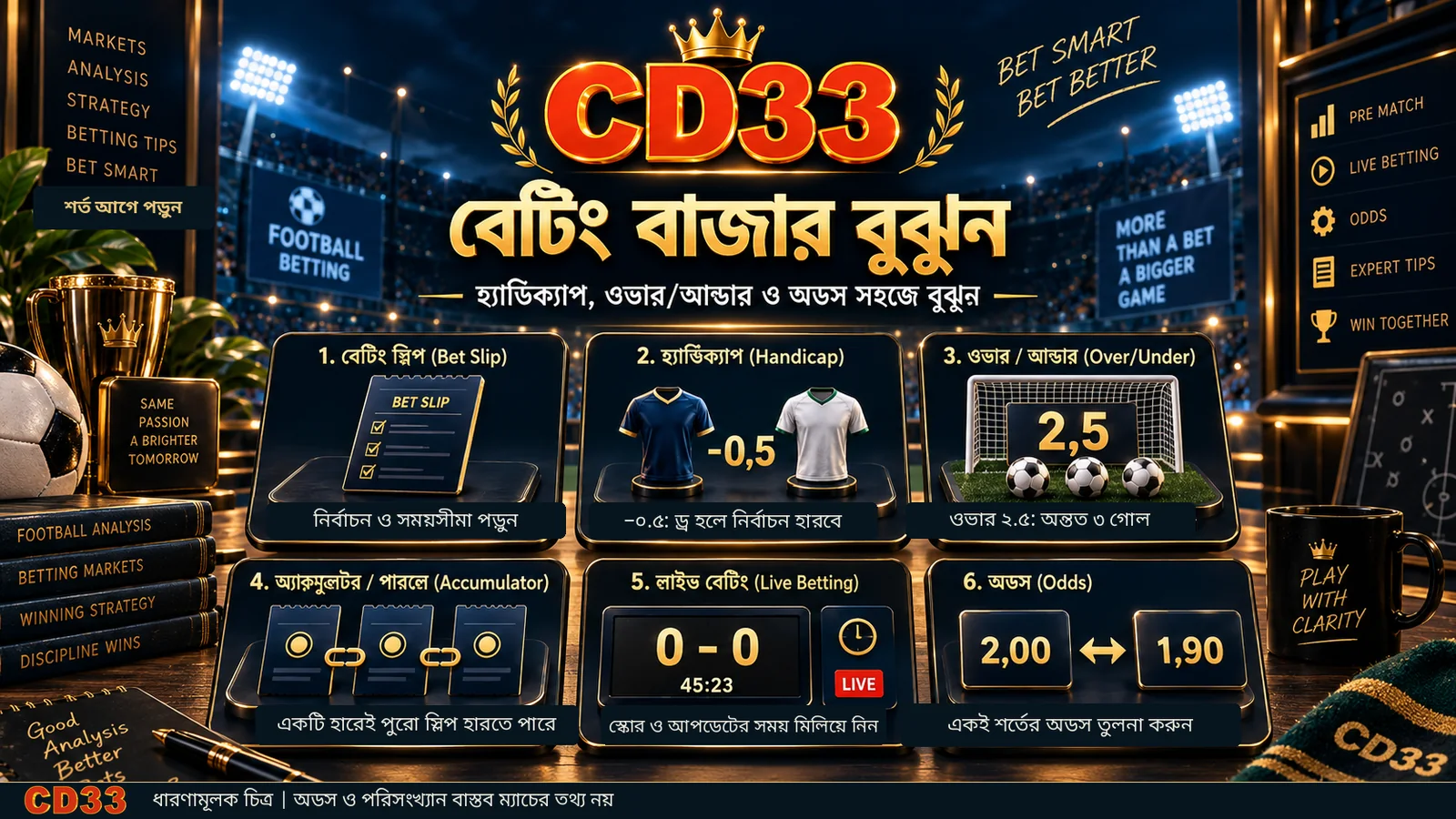
Common bet types: rules and examples
This section from CD33 covers six familiar topics for comparison. These are examples to help you read selections, time periods and return calculations, rather than strategies that guarantee a win. The terms on the actual bet slip govern the selection concerned.
Swipe sideways to view the whole table
| Type | What to check | Examples and limits |
|---|---|---|
| Single bet | Read the match, team and period used to settle the selection. Compare the slip's description with the information you have read. | “Team A to win in regulation time” and “Team A to qualify” are different selections. The team could draw in regulation time and still progress after extra time or penalties. |
| Handicap bet | Check which team the handicap is beside, its sign and the number of goals involved. Do not interpret the figure before understanding the conditions for winning, losing or receiving a refund. | For a Team A −0.5 selection to win, Team A must win within the specified period. A draw means the selection loses. The −0.5 line is not a free head start or a promise of safety. |
| Over/Under | Read the total goals or points line and establish whether it covers the whole match or one half. The same figure over a different period is a different selection. | Over 2.5 goals requires at least 3 goals in the applicable period; 2 are not enough. If the selection covers only the first half, second-half goals do not count. |
| Accumulator | Alongside each match and market, read the rules for cancelled or postponed events. Do not keep adding selections simply to increase the displayed total return. | On a slip with three selections, just one losing selection can make the whole slip lose. Winning the other two does not guarantee separate payouts. |
| Live betting | Read the score, minute or over and odds together. If the sources do not agree, check first; do not rely only on the speed of updates. | If the video shows 0–0 but the scoreboard says 1–0, the video feed may be delayed. Do not use old footage to establish the current position. |
| Comparing odds | Compare only the same match, selection and settlement conditions. Distinguish the total return from profit. | For a hypothetical ৳100 bet, a win at odds of 2.00 returns ৳200 in total; at 1.90 it returns ৳190. Both include the original ৳100 stake, so the profits are ৳100 and ৳90 respectively. |
Check step by step
Check information before, during and after the match
This section brings the earlier points together. The aim is to understand what you are selecting, which information has been confirmed and how much you could lose if the outcome is not what you expect.
Before the match: check form and confirmed line-ups
In football, look beyond the number of wins to the individual scores and opponents. Two teams winning their last three matches does not mean they performed to the same standard against different opposition.
Separate home and away results. In cricket, consider the format alongside the line-up, toss result, pitch and weather. Do not apply statistics from one format directly to another.
Compare odds only when the conditions match
Two prices on the same match are not necessarily for the same selection. Winning in regulation time is different from progressing after extra time or a penalty shoot-out.
For an example in Bangladeshi taka, a winning ৳100 bet at decimal odds of 2.00 pays ৳200 in total: the ৳100 stake and ৳100 profit. Read the current odds on the slip before confirming.
Set money and time limits from the outset
Before starting, decide your spending limit and stopping time. Keep this money separate from living expenses, education costs, debt repayments and emergency savings.
Do not increase your stake just because you have won, or add money to cover a loss. No fixed-percentage rule guarantees that your budget will remain intact.
For cricket, check which part of play the selection covers
A selection on total runs, wickets or a batter's performance may cover one over, one innings or the entire match. Read the scope as well as the odds.
Remember that 10.2 overs means 10 overs and 2 valid deliveries. If a match is shortened, check the announcement and the settlement conditions for that selection; do not calculate from the displayed score alone.
Cross-check live information and early settlement
During play, read the score, minute or over alongside the odds. If the video and scoreboard do not match, check before proceeding.
When a Cash Out offer appears, read the amount carefully and check whether settlement has been confirmed. The offer may be lower than the original stake. Ending a bet and guaranteeing a profit are different things.
Read the terms again when a promotion applies
Before registering, check eligibility, minimum deposits, wagering requirements, deadlines and withdrawal limits. There is no need to spend more just to obtain a particular benefit.
If you do not understand a term, ask. Do not assume a bonus on the screen is money you can withdraw immediately.